
Victory Park is one of Yerevan’s largest and oldest public parks, offering panoramic views of the city and Mount Ararat that make it a favorit spot for locals and visitors alike. The first steps toward creating the park were taken back in the 1930s, when the site of today’s green oasis was just an abandoned wasteland.
Landscaping began in the 1930s–1940s as part of Lenin Subbotniks—active community initiatives aimed at urban improvement. Initially, it was called Arabkir City Park. Later, after the end of the Great Patriotic War, the park received a new name — Victory Park.
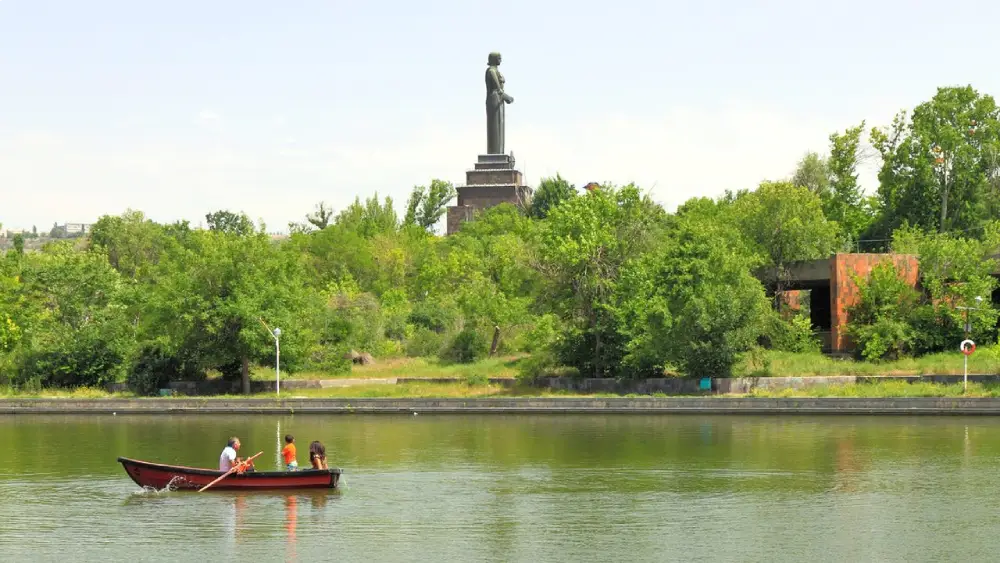
In 1950, a massive 50-meter-high statue of Stalin (sculptor S.D. Merkurov, architect R.S. Israelyan) was erected in the park, and around it, a cultural and recreation area was established, which people began to call “The Monument.” The Arevik Pond was constructed between 1958 and 1961; it replicates the shape of Lake Sevan and reaches a depth of 8.5 meters. Visitors could swim there or take boat rides.
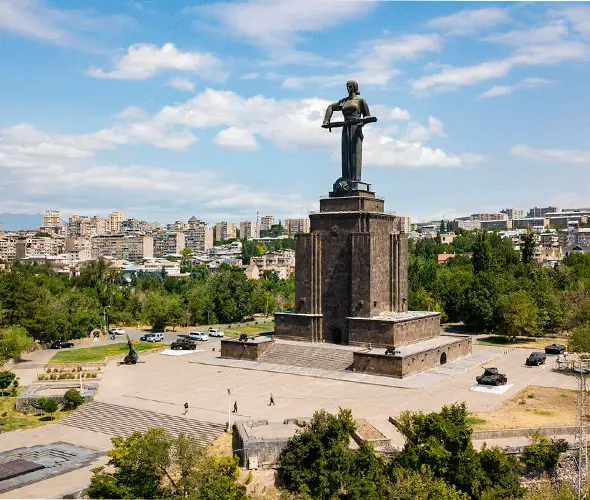
In 1962, the statue of Stalin was removed from its pedestal, and in 1967 it was replaced by the Mother Armenia statue (sculptor A.A. Arutyunyan) — a figure of a woman holding a sword with a shield at her feet, symbolising the Motherland and Armenia’s unwavering determination to defend its people.
In 1970, the Tomb of the Unknown Soldier with an Eternal Flame was added to the park, and the Alley of Heroes was laid from the Victory Monument to the tomb.
In 1977, the sculpture “No to War” (“Let There Never Be War”) (architect: Felix Zargaryan, sculptor: Vahan Khachikyan) was installed in the park, becoming a symbol of peace and a reminder of the cost of war.
In the 1990s, during the energy crisis and blockade that gripped independent Armenia, Victory Park, like many green zones in Yerevan, suffered from mass deforestation. The area was abandoned, and later a significant portion was sold off and built over with private residences. Despite later efforts, the former forested area could not be restored.
In 2011, a large-scale renovation of the park was carried out with the support of philanthropist Ruben Vardanyan.


Comment (0)